
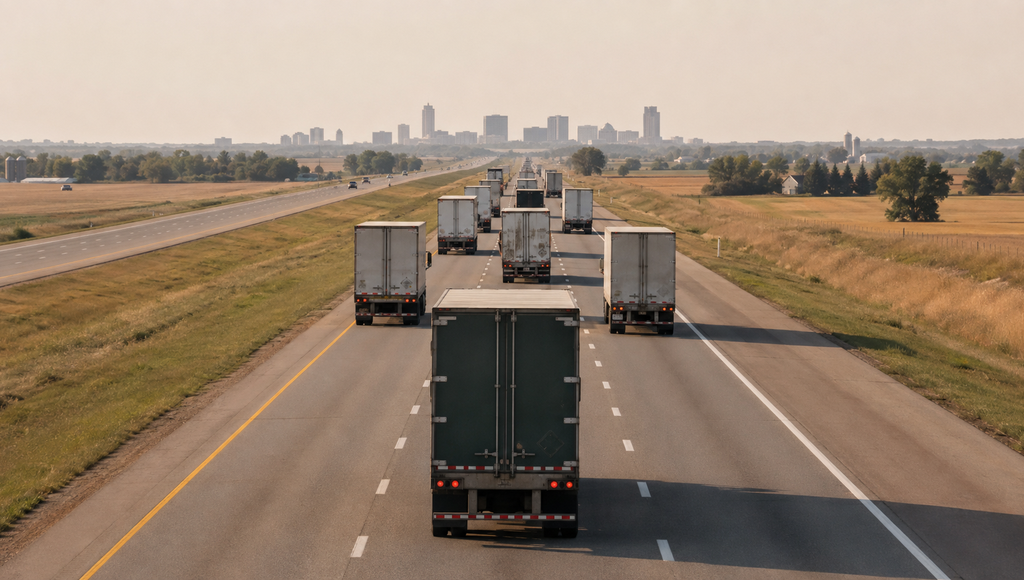
We spent most of last week telling shippers the same thing, and none of them wanted to hear it. Their lanes are about to get tight, and it has nothing to do with their freight. Nothing they can point to on their own end explains it. Their volume is flat, their customers are steady, their business looks like it always looks. The trouble is coming at them sideways, off the ocean, from freight they will never touch and mostly never think about. A wave of imports is landing at the coast, and it is going to eat the trucks they were counting on.
Where the Boxes Go After the Boat
A container that comes off a ship still has to get where it is going, and it gets there by truck. First a short haul off the dock to a nearby warehouse. Then the goods get unloaded and reloaded onto other trucks for the trip inland. Each of those moves takes a driver and a tractor. So a surge of imports stops being about ships the moment the boxes hit the ground. It turns into demand for trucks, and those are the same trucks a domestic shipper needs for ordinary freight.
The volume this year is unusually high, and it arrived earlier than usual. Importers pulled their orders forward to get ahead of the tariff increases, which pushed a lot of the normal fall freight up into the summer. Much of it is already here, sitting in warehouses and working its way inland in stages. And more keeps coming, because each new tariff deadline sets off another round of front-loading.
So a large amount of import freight is spreading out from the ports across the whole fall, and every load of it needs a truck. Your domestic freight is competing for capacity in that same market, drawing from the same pool of drivers and equipment, whether you import anything or not. You never ordered a single box of it, and you are still paying for it.
The Ripple You Feel Last
The reason this catches domestic shippers off guard is that it reaches them last. It does not hit everywhere at once. It moves inland from the coast in stages, and inland shippers sit at the end of that chain.
The first trucks affected are the ones that pull containers straight out of the port. That pressure is already building. Next come the trucks that carry goods from port-area warehouses to regional ones. After that, the trucks that move freight from the regional warehouses toward wherever it finally sells. By the time the tightness reaches a lane well inland, weeks may have passed since the ship arrived. You never saw that ship, and nothing reached you about conditions at the port. What you notice, one ordinary week, is that a lane you have run for years has gone tight and expensive and you cannot say why.
That delay is what makes the cause so hard to spot. The imports driving it are far away, and nothing on your own reports draws a line between the two. So you look for a reason in the usual places, in your own freight and your own market, and you come up empty, because the reason was never there to begin with. It was at a port you have no cause to think about.
It works the way any delayed consequence works. The cause happens at the coast, the effect takes time to travel inland, and it lands on a distant lane well after the fact. That lag is the main reason the connection gets missed. By the time a shipper feels it on a lane, the event that caused it is old news back at the port, if it ever made the news at all.
Why This Fall Bites Harder
The bigger problem is what this import freight is landing on. A truck market that was already short on capacity before any of it arrived.
Capacity has been leaving the market for a while now. Carriers closed during the long downturn. Drivers left the seat and did not come back. New rules have pushed still more drivers off the road. The pool was already thin before a single extra container showed up. Add a full season of import freight to a market that short on trucks, and the pressure does not rise gradually. It rises sharply, because there is no slack left to absorb it. When a market has plenty of spare trucks, a wave of new freight moves through it without much strain, but a market already running short has nowhere to put the extra, so rates move fast and coverage gets unreliable. That is the market heading into this fall. The import freight is not the whole reason trucks are tight, but it is the push that turns an already-tight market into a genuinely hard one, and it arrives right as the fall shipping season gets going.
Fuel is adding to the confusion. Diesel eased earlier in the summer, and a lot of shippers read that as the market loosening. It was not. Fuel costs and capacity are separate problems, and only fuel improved, briefly, and it did not hold. The shipper who reads lower fuel prices as loosening capacity is the one who gets caught off guard when import freight starts consuming trucks.
Which means a shipper looking at calm conditions on familiar lanes in September is watching the wrong indicator. The pressure is building at the coast, and the trucks are already scarcer than the quiet makes them feel.
Getting Ahead of It Instead of Under It
Seeing the squeeze coming only helps if you act on it. There are two practical steps, and neither is complicated.
The first is to figure out whether you are exposed at all. Not every shipper is. But if your lanes run near the major port regions, or through the inland hubs where import freight concentrates, you are exposed whether you import or not. Knowing that ahead of time is most of the work. It tells you which of your lanes are at risk and which ones will ride the fall out fine. Most shippers have never mapped this, and could not tell you which of their lanes overlap with the import corridors. Working that out costs almost nothing, and it is worth doing before the pressure arrives rather than after. A short review of your lane list against where the freight funnels inland is usually enough to show you where you stand. Focus your planning on the exposed lanes. Everything else you can mostly leave alone.
The second is to secure capacity early on the exposed lanes, before demand peaks. The trucks are available now. They get much harder to secure once the import freight is at its height and shippers across the country are competing for the same limited pool. A shipper who commits capacity during the quiet stretch pays a reasonable rate. A shipper who waits until the lane is already tight negotiates from a weak position and pays whatever the day demands. Two shippers with identical freight on an identical lane can pay very different rates, and the difference is often nothing more than who moved sooner.
This is also where a good broker earns the fee, because watching these conditions is the work. A sharp one tracks where the import freight is landing, which inland lanes are about to feel it, and where capacity still is, well before any of it shows up on your invoice. That view is hard to build on your own, from inside a single operation looking at its own freight. It takes watching the whole market at once, which is what a broker focused on these lanes does all day. When the pressure starts to build, the broker already knows, and your freight is already covered.
That is the real value of the relationship, and it is worth being plain about it. A broker who only quotes you a rate when you call is not doing this part. The one who is worth having is watching the market between your calls, flagging the lanes that are about to move, and lining up capacity before you are the one asking for it. In a normal market the difference is small. In a fall like the one shaping up, it is the difference between a covered load at a fair rate and a scramble at a bad one.
The Bottom Line
The freight stacking up at the ports this fall will not stay there. It moves inland by truck, in stages, using up capacity along the way, and it lands on the lanes of domestic shippers who import nothing and did not see it coming. An import surge, an already-thin truck market, and a fuel dip that created a false sense of ease all combine into a fall that runs tighter than current conditions suggest.
You do not have to be caught by it. The shippers who come through this in good shape are the ones who identify their exposure, secure capacity early on the affected lanes, and work with someone watching the whole market instead of a single corner of it. None of that comes down to luck. It comes down to recognizing the pressure in advance and acting before it lands, which is far easier with someone keeping an eye on the coast for you while you run your business. If you want help figuring out which of your lanes are exposed, and how to get ahead of the surge, that is the kind of thing we work on every day.
Want to know which of your lanes are exposed to the fall import surge, and how to lock in capacity before it peaks? Let's talk it through.
📞 (931) 200-5601 | [email protected]
This one drew on the late-summer import reporting from the National Retail Federation and Hackett's port tracker showing an early, tariff-driven peak that pulled fall volume up into the summer, plus the Descartes and Loadstar coverage of containers surging as importers front-loaded ahead of the tariff deadlines. The picture of the squeeze creeping inland from drayage to truckload came from the ITS Logistics freight index warning that container haulage rates tighten once peak lands, and the C.H. Robinson drayage update on how a calm-looking port can hide real strain past the terminal gate. And the read that all this is coming down on an already-thin truck market, with the fuel dip a separate and temporary thing rather than real capacity relief, lines up with the August market commentary on why capacity stays tight even while diesel and spot rates bounce around.